


The Sextant Explained: A Pivotal Device for Maritime Navigation
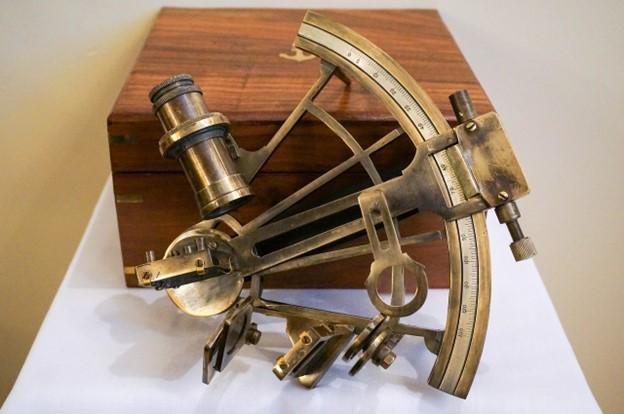
A sextant is a vital navigation instrument used to determine a ship or aircraft's position by measuring angular distances between celestial objects. Sextants provide critical latitude and longitude data for maritime and aeronautical navigation.
What is a Sextant?
A sextant consists of a precision optical instrument mounted on a metal frame. It utilizes a graduated arc, mirrors, and filters to measure the vertical angle between a celestial body like the sun or stars and the horizon. This angle provides the observer’s position line on a navigational chart.
Sextants trace their origins back to the early 1700s. They were widely used for marine navigation until being surpassed by modern satellite navigation in the 1980s and 90s. While less common today, sextants remain an integral part of a navigator’s toolbox as a backup to electronic systems.
Parts of a Sextant
Sextants have various components that allow them to take accurate measurements:
- Frame - Sturdy bracket that houses the arc, shades, telescope, and mirrors
- Index arm - Moving arm attached perpendicular to the frame with sights and filters
- Arc - Graduated arc marked in degrees to measure angles
- Horizon shades - Colored shades to filter the horizon for optimal visibility
- Mirrors - Two mirrors align images from the celestial body and horizon
- Micrometer - Fine adjustment knob for precise measurement
- Telescope - Magnifies celestial images entering the optical path
- Handles - Allows the user to steadily hold and manipulate the sextant
Using a Sextant
Taking an angular measurement with a sextant involves several steps:
1. Determine the celestial body to be used - Typically the sun or identifiable stars.
2. Set the micrometer to zero and point the sextant towards the horizon.
3. Look through the telescope and align the celestial object in the field of view.
4. Adjust the index arm until the horizon is also visible in the mirror.
5. Carefully adjust the micrometer until the celestial body and horizon form one distinct image.
6. Read the precise measurement in degrees off the arc.
7. Record the time and measurement for chart plotting.
8. Take 3-5 measurements for averaging and error correction.
Note that sextant operation requires skill and practice to take accurate sightings. Users must factor in the celestial object's expected position and elevation at a given date and time.
Sextant Navigation
With angular measurements from a sextant, navigators can determine their position line using sight reduction tables. By taking observations of different celestial bodies that provide intersecting position lines, the exact current position can be fixed.
Sextants provide vital data to plot and confirm a vessel's course during transit across open waters. They serve as a reliable navigation backup for GPS, radar, and other modern systems prone to failure. Sextants were critical for explorers and sailors prior to electronic navigation.
Today, sextants remain part of training for professional mariners and recreational boaters alike. Those who practice the art of celestial navigation keep traditional skills alive and retain the ability to navigate by the sun and stars. For certain remote journeys, a trusty sextant may be technology enough.
While newer technologies have replaced the sextant operationally, its principles live on in the workings of modern inertial navigation systems. For those interested in traditional techniques or planning offshore passages, a good sextant is still worth its weight in gold.