

V-Drive vs Forward Drive: How Engine Alignment Impacts Boat Performance
Key Takeaways:
Design Differences: V-Drive and Forward Drive have distinct designs, with V-Drive being traditional and Forward Drive being more innovative.
Performance: Each drive system offers different performance characteristics in terms of speed, handling, and fuel efficiency.
Application Suitability: The choice between V-Drive and Forward Drive often depends on the type of boating activity - like leisure, speed, or watersports.
When it comes to powering recreational boats and yachts, two of the most common marine propulsion systems are V-Drive and Forward Drive setups. Both provide ample thrust to push vessels to high speeds on the water. But they have some key differences in their configurations, performance attributes, maintenance needs, and costs.
What is a V-Drive System?
V-Drive systems get their name from having a V-style gearbox mounted between the engine and propeller to redirect the thrust by 90 degrees. This allows boat builders to install the engine facing backwards in the hull while the propeller still pushes water rearwards beneath the transom for forward movement.
The V-Drive transmission employs a series of bevel gears to transfer power from the vertically mounted engine to the horizontal propeller shaft. Many V-Drive systems use a 1:1 gear ratio, meaning propeller RPM matches engine RPM. Though lower gear ratios like 1.23:1 or 1.5:1 are also common to increase thrust for heavier boats.
Benefits of V-Drive Setups
Positioning the engine backwards frees up ample interior space since the powerplant is mounted behind instead of under passenger areas. This optimized space gives the versatility to have larger cabins in performance boats. It also keeps engine heat, noise, and vibrations isolated from passengers for a more comfortable ride.
Accessing the engine is easier with rear-facing orientation since opening the aft hatch provides complete access without cramping the engine below decks. Technicians can easily inspect components and perform routine maintenance on V-Drive power systems.
V-Drives also allow boat designers to experiment with radical hull shapes thanks to flexible propeller placement further aft from the keel line. Manufacturers leverage this to optimize hull efficiency in race boats and other specialized craft.
What is a Forward Drive System?
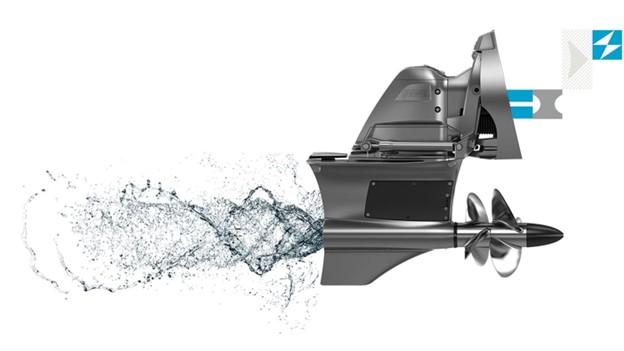
In contrast with V-Drive setups, Forward Drive boats have their engines conventionally mounted facing forwards with the propeller shaft extending forwards from the front of the gearbox. This configuration keeps the propeller directly in line with the engine’s thrust without any redirection involved.
Instead of gooseneck exhaust routing needed for rearwards facing engines, Forward Drive systems employ simple vertical exhaust stacks for gas discharge thanks to the engine’s frontwards orientation.
Benefits of Forward Drive Setups
The simple, linear power transfer path in a Forward Drive setup avoids the additional friction and chances of slippage inherent to redirected V-Drive transmissions. So Forward Drives offer marginally better fuel efficiency thanks to less parasitic losses in delivering engine power straight to the prop.
The streamlined layout also reduces noise and vibration by eliminating the gear mesh rumble emanating from V-Drive gearboxes. This makes for more comfortable extended cruising. It also allows for quieter conversations in the cockpit without the constant gear whine associated with V-Drives even at idle or low speeds.
Forward Drive boats also tend to have a shallower draft thanks to less protruding running gear mounted closer to the hull’s centerline rather than hanging further beneath the transom. So they are well suited to navigating thin waterways.
Maintenance Considerations
When it comes to reliability and maintenance, V-Drive systems are clearly more intricate. All those additional moving parts in the transmission and steerable outdrives introduce more opportunities for wear and tear over time. This demands closer inspection intervals and more frequent lubrication of universal joints and bearings prone to deterioration from exposure.
So while routine maintenance may cost moderately more on V-Drive boats, their overall engine access generally makes servicing simpler than working around cramped Forward Drive engine compartments. This can offset some of the pricing differences in caring long term for either propulsion platform.
One advantage of Forward Drives is technicians don’t have to dismantle exhaust routing to access drive components. And should major gearbox work ever prove necessary, the engine can be serviced independently without disturbing the propulsion gear in most cases.
Performance Attributes
Thanks to their efficient force transfer, Forward Drive boats often planes faster and offers snappier handling which many perceive as an agility advantage. The physics of directing thrust from the gearcase mounted further aft gives V-Drive boats more straight-line stability. This allows them to better maintain heading at high speeds.
So V-Drives dominate applications like offshore racing catamarans where their directional stability is critical. They also work better than Forward Drives for wakeboarding thanks to cleaner torque translation enabling smooth, consistent wake shapes for extended trailing.
Cost Considerations
Over the long run, V-Drive systems generally entail higher ownership costs mostly stemming from their more intensive maintenance needs. The transmission fluids, universal joints, bearings, and seals required greater inspection and more frequent replacement in V-Drive packages.
So while purchase pricing is largely comparable for boats outfitted with Forward or V-Drive platforms, the compounded expenses of parts and labor over years of use tends to be higher for V-Drive systems. This mostly owes to their intricate nature introducing more upkeep requirements as service intervals dictate.
Making the Choice
When deciding between Forward and V-Drive propulsion, start by considering your priorities. V-Drives allow more versatile boat design with their compact backending of the engine. But their added complexity demands more intense mechanical upkeep over time. Forward Drives have simpler maintenance thanks to fewer components. But their inline design hampers interior space and flexibility compared to V-Drive layouts.
| Feature | V-Drive | Forward Drive |
| Design | Traditional rear-facing propeller | Forward-facing propeller |
| Performance | Better for cruising and larger waves | Enhanced for watersports |
| Handling | Stable at higher speeds | Improved low-speed maneuverability |
| Fuel Efficiency | Generally less efficient | More fuel-efficient due to design |
| Safety | Standard safety features | Increased safety for watersports |
| Cost | Generally less expensive | More expensive due to newer technology |
So scrutinize whether your boating plans call for prioritizing interior volume and weight balancing enabled by V-Drives or favor the simpler upkeep of Forward Drive systems. Test driving boats with each platform can help inform your decision based on performance needs too. From there, weighing the long term service considerations can help determine if lower maintenance Forward Drive or versatile V-Drive propulsion is the best fit.