

Volvo Penta vs Mercury MerCruiser Sterndrive Engines: A Comprehensive Comparison

Key Takeaways:
- Volvo Penta engines excel at low-end torque while Mercury optimizes top-end horsepower.
- Volvo Penta offers innovative features like Forward Drive but has fewer engine choices.
- Mercury MerCruiser is used by more boat builders and has more widespread service locations.
- Fuel injection, catalytic converters, and closed cooling systems are standard for emissions compliance.
- Consider power, features, maintenance costs, availability, and warranties when choosing.
When selecting a sterndrive power package for your boat, two of the leading brands to evaluate are Volvo Penta and Mercury MerCruiser. Both companies offer a range of engine options paired with their proprietary outdrive units. While the two brands have some similarities, there are also important differences to consider when deciding between Volvo Penta vs Mercury MerCruiser for your next repower or new boat purchase.
| Feature/Aspect | Volvo Penta | Mercury MerCruiser |
| Power Characteristics | ||
| Horsepower & Torque | High torque at lower RPMs, good for acceleration & towing | Less peak torque, higher horsepower at high RPMs |
| Example (5.3L V8) | 270 lb-ft @ 3500 RPM, 270 HP @ 4800 RPM | 250 lb-ft @ lower RPM, 300 HP @ 5000 RPM |
| Innovative Technologies | ||
| Forward Drive | Available on select models, enhances maneuverability | Not available |
| Corrosion Protection & Other Tech | Active corrosion protection, Triple Power, EVC, etc. | SmartCraft digital integration system |
| Drive Design | ||
| Outdrive Profile | Angled profile for space efficiency & hydrodynamics | Alpha drive for strength & durability, robust construction |
| Steering & Exhaust Flaps | Hydraulic power steering, efficient exhaust flaps | Hydraulic power steering, efficient exhaust flaps |
| Service & Support | ||
| Service Network | Less extensive, potentially longer wait times | Widespread, easily accessible service locations |
| Warranty | 2-year limited warranty | 3-year warranty |
| Emissions & Environmental Impact | ||
| Compliance & Technologies | EPA Tier 3 compliant, SCR for diesel, fuel-efficient | EPA Tier 3 compliant, TWC converters, fuel-efficient |
| Sustainability Efforts | Focus on fuel efficiency, recyclability, responsible manufacturing | Standard emission compliance |
| Other Considerations | ||
| Use Cases | Better for tow sports and low-end power | Better for top speed performance |
| Model Range | Fewer engine choices | Wider selection of engine sizes |
| Resale Value | High | High |
By looking closely at specifications like horsepower, torque, engine technology, drive designs, serviceability, emissions compliance and other factors, you can better understand the advantages of each brand and choose the optimal package for your needs.
Horsepower and Torque Characteristics
One of the most important considerations when choosing an engine is the power output. Volvo Penta and Mercury MerCruiser take slightly different approaches when it comes to optimizing horsepower and torque.
Volvo Penta sterndrive engines emphasize high torque, especially at lower RPM ranges. This gives them excellent acceleration and power when taking off from a standstill or towing skiers. Volvo's 3.0 liter and 5.3 liter engines offer more torque per liter of displacement compared to Mercury's blocks in the same range.
Mercury MerCruiser engines tend to provide less peak torque, but reach higher horsepower numbers at higher engine speeds. So they can provide greater top end speed once up on plane. Mercury's large displacement 6.2, 8.2, and 9.0 liter sterndrive engines are capable of generating 400+ horsepower for bigger boats.
For example, Volvo Penta's 5.3L V8 engine puts out 270 lb-ft of torque at 3500 RPM along with 270 horsepower at 4800 RPM. Mercury's 5.7L sterndrive V8 makes 250 lb-ft of torque at lower RPM but generates 300 horsepower at 5000 RPM.
So while Volvo Penta may get your boat onto plane quicker, Mercury MerCruiser can ultimately reach faster top speeds once optimum momentum is achieved. The difference is most noticeable with larger offshore boats and yachts over 30 feet.
Knowing your typical use case, whether it's tow sports and low end power or top speed performance, can help determine whether Volvo or Mercury's power delivery is a better match.
Innovative Volvo Penta Engine Technologies
In addition to their high torque outputs, some Volvo Penta marine engines offer innovative technologies and features that set them apart from competitors. A few examples include:
- Forward Drive – Volvo's unique Forward Drive outdrive design allows the entire drive unit to rotate 90 degrees and pivot the propellers forward. This gives exceptional maneuverability for docking and operating in tight spaces. Forward Drive is available on Volvo's D3, D4 and D6 diesel sterndrive packages.
- Active Corrosion Protection – To prevent galvanic corrosion, Volvo Penta engines emit a low voltage current through the coolant water to form a protective layer on internal engine surfaces exposed to seawater. This helps minimize deterioration over time.
- Easy Boating App - Volvo Penta's mobile app provides remote access to engine data, diagnostics and track mapping from Bluetooth-enabled Glass Cockpit Systems. No need to be aboard to check engine hours or get service reminders.
- Triple Power - An innovation available on certain dual prop Volvo Penta drives, Triple Power alternates power between the dual outboard and middle propellers to balance top speed, acceleration, fuel efficiency and noise reduction.
- EVC – Electronic Vessel Control integrates the engine, transmission, power steering and other components under digital control for optimum performance.
Mercury MerCruiser engines also offer advanced features like their SmartCraft digital integration of vessel electronics and instrumentation. However Volvo Penta's innovations give them a unique technological edge in certain areas.
Sterndrive Design and Engineering
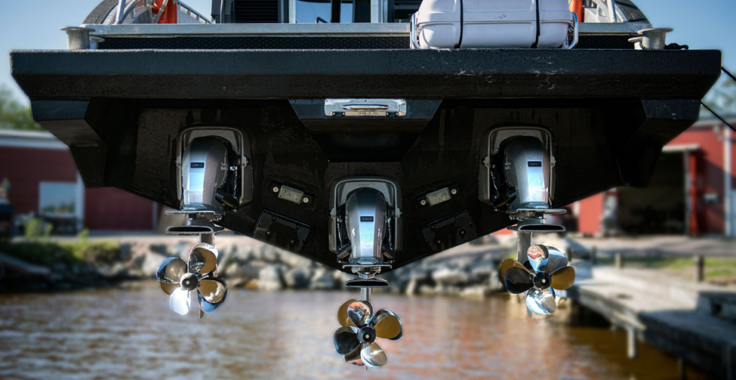
Beyond the engines themselves, there are some noteworthy differences in how Volvo Penta and Mercury MerCruiser design and engineer their sterndrive systems.
Volvo Penta utilizes an angled profile on their outdrives which shifts the props farther back from the transom. This frees up more space for the swim platform while reducing noise and vibration in the cockpit area. Volvo's conical shape also improves hydrodynamics and allows cleaner water flow to the propellers.
Mercury MerCruiser employs what they call the Alpha drive, a gearcase engineered for greater strength and durability. The Alpha drives use components like stainless steel clevis pins, silicon bronze bearings and nickel aluminum silicon carbide propshaft surfaces for extended fatigue life. This robust construction makes them well suited to larger offshore boats and saltwater use.
Both brands offer hydraulic power steering on their sterndrive setups for smooth and responsive handling. They also use exhaust flaps to optimize exhaust gas flow through the propellers for added thrust and performance.
One knock against Volvo Penta sterndrives is that the angled gearcase design restricts access to the engine for maintenance and repairs compared to Mercury's drives. The trade-off is a more streamlined and hydrodynamic package.
Mercury's Widespread Service Network
Since Mercury Marine has been in business for over 75 years and supplies engines to a majority of boat brands, their service network is far more extensive compared to Volvo Penta. Mercury certified dealers and mechanics are readily available at marinas across North America and beyond. OEM parts and supplies are also easier to source locally for Mercury engines.
This gives Mercury MerCruiser powered boats a service advantage over Volvo Penta models, especially outside major metropolitan areas. Locating a Volvo Penta certified technician could mean longer wait times for repairs or routine maintenance. For boaters who rely on service availability, Mercury's widespread infrastructure is a strong point in their favor.
On the other hand, Volvo Penta offers a 2 year limited warranty on new recreational use engines compared to 3 years for Mercury MerCruiser. So Volvo provides less potential coverage but may be harder to utilize depending on your boating location.
Emissions, Fuel Efficiency and Environmental Impact
With environmental regulations in the marine industry getting stricter, both Volvo Penta and Mercury Marine have developed technologies to make their engines significantly cleaner and more fuel efficient.
All current Volvo Penta and Mercury MerCruiser sterndrive engines meet the EPA's Tier 3 emissions standards for marine engines. Key measures used by both brands include:
- Closed crankcase ventilation – Prevents blow-by emissions from entering the atmosphere.
- Electronic multi-port fuel injection – More precise fuel delivery results in more complete combustion and reduced hydrocarbon exhaust.
- Catalytic converters – Oxidizes hydrocarbons and reduces nitrogen oxides for cleaner emissions.
- Water-cooled exhaust manifolds – Lowers combustion temperatures for less NOx output.
In addition, Volvo Penta employs selective catalytic reduction or SCR on their diesel drive systems. SCR injects urea fluid to convert NOx into nitrogen gas and water for lower emissions.
Mercury MerCruiser uses three-way catalyst or TWC converters for efficient exhaust treatment. The TWC design eliminates hydrocarbons, nitrogen oxides and carbon monoxide simultaneously.
While both engine brands meet EPA standards, Volvo Penta highlights their vision for more sustainable power solutions. This includes prioritizing fuel efficiency, recyclable materials and responsible manufacturing processes.
Factors to Consider When Choosing
When deciding between Volvo Penta vs Mercury MerCruiser for your next sterndrive package, keep the following factors in mind:
- Engine power – Evaluate torque versus horsepower needs for acceleration, towing, and top speed.
- Innovative features – Assess benefits of technologies like Volvo Forward Drive.
- Drive design – Conical Volvo shape or robust Mercury construction.
- Service availability – Widespread Mercury dealers vs limited Volvo Penta.
- Warranties – Volvo 2 year limited, Mercury 3 year.
- Brand reputation – Both have long histories of reliable performance.
- Range of models – Mercury has wider selection of engine sizes.
- Resale value – Both brands command higher used prices.
- Environmental impact – Volvo Penta aims for sustainability leadership.
By carefully weighing your priorities in terms of power delivery, features, serviceability, emissions profile and overall value, you can select the ideal sterndrive engine brand for your boating application. Test driving boats equipped with each provides further insight into real world performance differences. Whether you choose innovative Volvo Penta or the extensive Mercury MerCruiser service network, either option offers powerful and reliable performance.